 New Ability Energy
The questions we are asked first.
If yours is not here, ask it. The answer is usually a site visit away.
What does a site visit involve?
A recent electricity bill, access to your interval data, and a site visit. From that we model your load, check the switchboard and the roof or ground area, and write the assumptions up with the proposal.
How is the system sized?
Against your actual load and tariff rather than against available roof area or a package off a price list. We model your load shape, check network export limits and switchboard capacity, and size the array and inverters to what the site actually uses. Where a battery earns its keep, it is modelled the same way before a kWh figure is put on paper.
Can you work around a live site?
Yes. The team that designs the system is the team that commissions it, and shutdowns are planned around your operating hours. The window is confirmed in writing before we start.
Who actually does the installation?
Our own licensed in-house electricians and installation crews. The people who specify your system are the people who install it, the job is held under one contract, and the warranty is held here.
What happens after commissioning?
Monitoring runs from day one. You receive the commissioning documents and warranties, a servicing schedule is agreed, and performance is checked against the model. Faults are flagged from the data rather than from a bill shock three months later.
Do you service systems you did not install?
Yes. Scheduled servicing and monitoring covers the systems we install and the ones we did not, and underperforming arrays are worth a look before they are worth replacing.
Commercial and industrial solar 6
Sizing, roof types, export limits and the thresholds that decide which scheme a system sits in.
How much does a commercial solar system cost?
There is no honest figure before the load is known. Cost follows the array size, the roof type and fixing method, the switchboard work required and the connection agreement, and the array size follows your interval data rather than your roof area. A recent bill, your interval data and a site visit come first, and the proposal carries the assumptions so you can check the working.
Why do so many commercial solar systems stop at 99 kW?
Because crossing 100 kW used to change which scheme you were in. Under the line a system created its certificates upfront, applied at the point of purchase. Over it you were in the mechanism built for solar farms, and a great many projects simply did not proceed. If your site was sized to 99 kW, the useful question is what it would have been designed as if the line had never been there.
Can you install on a warehouse or factory roof?
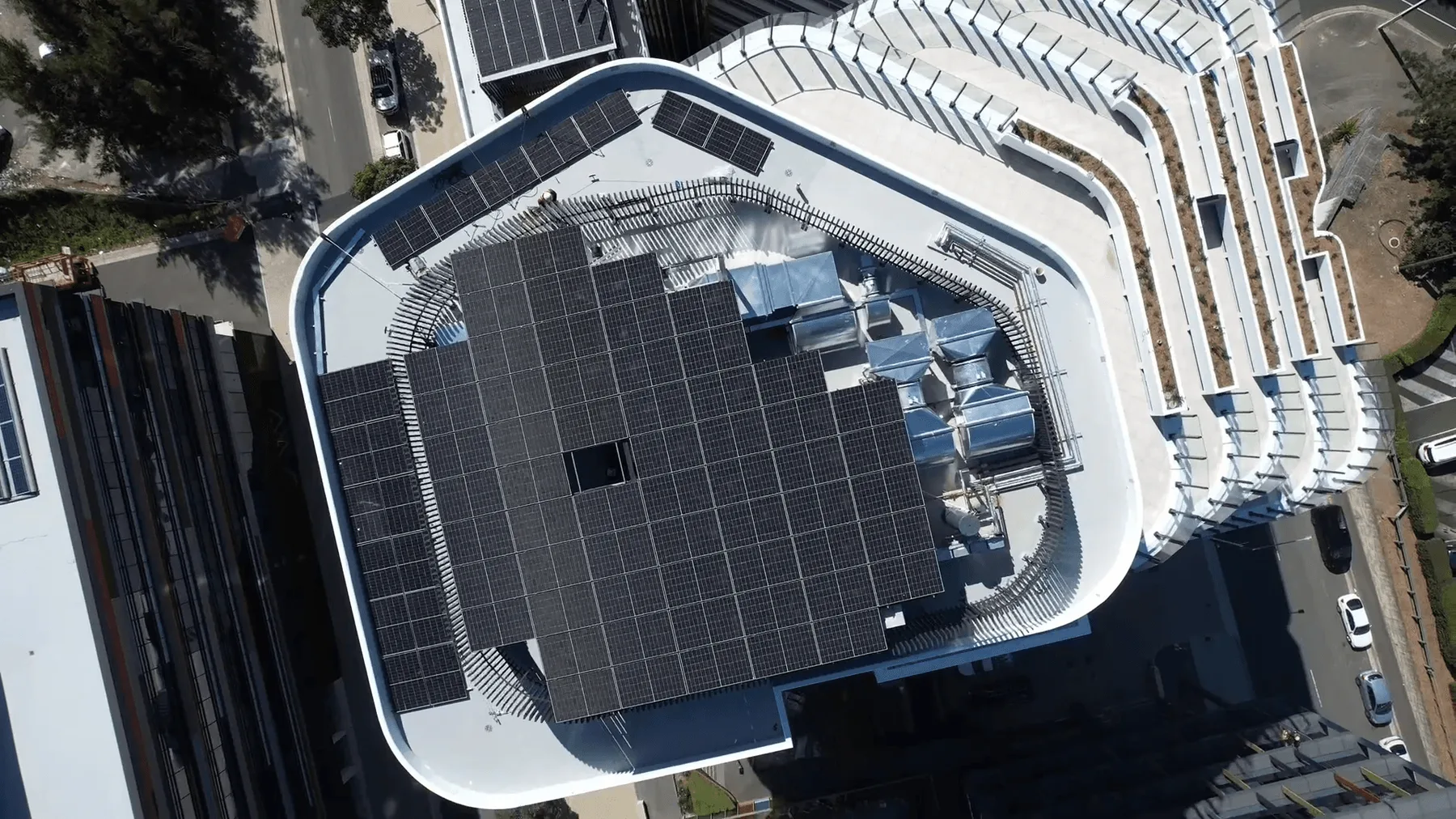
Yes. Klip-Lok, Trimdek, standing seam, membrane and tile are all routine, and the fixing method follows the sheet profile rather than the other way round. Roof age and structural capacity are checked at the site visit. Where a roof is near the end of its life we raise it before anything is installed on top of it.
What is an export limit and will it affect my system?
Network export limits cap how much generation can be sent back to the grid, which changes the value of anything produced above the site's own draw. It is one of two constraints that bind the design regardless of what the model wants, the other being switchboard capacity. Both are established at the site visit and written into the proposal as assumptions.
Do you install ground-mount and carpark solar?
Yes, alongside rooftop. Ground-mount and carpark structures bring footings, trenching and civil works into scope, and access and shading are assessed on site. They are quoted as one piece of work rather than a solar price with the civil works discovered later.
Does my site need three-phase power?
Most commercial and industrial sites are already three-phase, and inverter selection and phase balance follow what the switchboard can carry. A single-phase site has a lower practical ceiling, which is one of the things settled at the site visit before a system size is proposed.
Battery storage and backup 6
What a battery actually does on a commercial site, when it earns its keep, and when it does not.
Will a battery keep my power on during a blackout?
Only if it has been specified to. Backup needs nominated circuits, a changeover arrangement and an inverter able to run islanded from the grid. It is a design decision made at the start, not something added to a battery afterwards, so it is worth saying early if keeping specific loads alive matters to you.
How do I know whether a battery is worth it for my site?
It gets modelled the same way the array does, against your load shape and your tariff, before a kWh figure goes on paper. Sometimes the answer is a smaller battery. Sometimes it is no battery yet, and a switchboard that will take one later without being rebuilt. Saying so at quote stage is less comfortable than including it, and it is the only version that survives twenty years.
Can I add a battery to solar I already have?
Usually. It depends on the existing inverter and whether the battery is AC or DC coupled, on switchboard capacity, and on whether the existing array meets any ratio an incentive requires. If the array was sized for the building's load, as arrays normally are, it may still fall short of that ratio, and the fix is a resize.
What size battery do I need?
Sized on usable capacity rather than nameplate, and against the peak window you are actually trying to cover. Where an incentive is in play, the scheme activities set capacity bands, so the band and the load modelling have to agree before the design is settled.
Can the battery be charged from the grid?
It depends on which scheme the site sits under. The NSW Peak Demand Reduction Scheme exists to reduce demand on the network at peak times, and two of its three battery activities require solar on site at a fixed ratio to the battery. Read against that purpose, the solar requirement is consistent rather than arbitrary.
What is a virtual power plant, and should we join one?
A VPP aggregates batteries so they can be dispatched together, in return for a payment or tariff arrangement. Whether it suits you depends on the dispatch terms, what it does to your own peak cover, and how the operator's control interacts with the equipment warranty. Those terms are worth reading in full before signing, and they vary considerably between operators.
Rebates, incentives and certificates 7
The NSW and federal schemes by name, who each one covers, and what stacks.
What battery incentives are available in NSW?
NSW confirmed three new battery activities under the Peak Demand Reduction Scheme on 18 August 2026, commencing 1 September 2026. Which one applies to you turns on the building's classification, the usable capacity of the battery, and whether there is solar on site or in the same scope of works. Settling which activity applies is the first useful step, because the conditions attached to each are different.
What is the Cheaper Home Batteries Program?
A federal program covering households, small businesses and community organisations, delivered as an upfront reduction through small-scale technology certificates. Two conditions surprise people: the battery must be paired with solar, new or existing, and there is a grid connection condition. It is separate from the NSW activities.
Can I claim a NSW and a federal battery incentive together?
Some sites can. The apartment activity has been reported as stackable with the federal Cheaper Home Batteries Program up to a capacity limit. Whether it applies to your building is settled before a proposal is written rather than assumed, because the eligibility tests differ between the two.
What are STCs and LGCs?
Small-scale technology certificates are created upfront and applied as a reduction at the point of purchase, handled by the installer. Large-scale generation certificates accrue over years and are a revenue stream rather than a capital reduction. Which one a system creates has depended on where it sits against the 100 kW line, and that is what made the line matter.
Are there rebates for commercial solar between 100 kW and 1 MW?
From 1 October 2026, subject to the regulations being in place, systems in that band create small-scale technology certificates instead of large-scale generation certificates. The support is applied to the invoice rather than accrued over years, which is a different thing entirely. If you have a site in that band, the business case is worth re-running rather than re-deciding: the inputs changed, the site did not.
Is there a deadline to claim these incentives?
No. They are activities inside an ongoing scheme, not a promotion, so there is no closing date to work back from and no reason to rush a decision. Anyone using a countdown to move you along is telling you something about themselves rather than about the scheme.
Do the NSW battery activities cover homes?
No. The three activities are aimed at commercial and apartment buildings, not at houses. Homes fall under the federal program instead, which is a separate scheme with its own conditions.
Homes, apartments and strata 4
Residential solar and battery, common property, and who holds the contract.
Do you install residential solar and battery?
Yes. Residential solar and battery is retailed through Solar Up, the renewable arm of the business, and designed, installed, contracted and warranted by New Ability Energy. The same licensed crews and the same contract sit behind a home system as behind a commercial one.
Can an apartment building install a battery?
Yes, and one of the NSW activities is aimed specifically at apartment buildings. Common property, metering arrangements and strata approval are settled before design, because they decide who the system actually serves and how the benefit is distributed.
How does solar work for strata and common property?
What the system serves decides everything else. A system sized for common property load is a different design, and a different metering arrangement, from one intended to serve individual lots. That question is answered before the roof plan is drawn rather than after.
Will my roof suit solar?
Orientation, pitch, shading through the day, the sheet or tile type, the roof's age and the switchboard all decide it. Those are checked at a site visit rather than assumed from an aerial image, because the things that stop a job are usually the ones that do not show up from above.
Cost, payback and the proposal 5
Why the figure comes after the site visit, and what the proposal has to show its working on.
Why will nobody quote an exact figure before a site visit?
Because the answer depends on your load, and the load is not visible from outside the building. A recent bill, your interval data and a site visit come first. We request the data from your retailer with your permission, model the load against your tariff, check network export limits and switchboard capacity, and write the assumptions up alongside the proposal.
What actually drives the payback?
How well the generation shape matches the load shape, the tariff you are on, the export limit, and how much of what you generate you use yourself. A site that draws hard through the middle of the day and one that draws in the evening are buying different things from the same panels.
What is in the proposal?
The model, the assumptions behind it, and the network and switchboard constraints written down as constraints. Where the modelled return does not justify the capital, the proposal says so rather than quietly reducing the scope until the number works.
Can a commercial system be financed?
Arrangements vary, and how a system is best structured for your business is a question for your accountant or financier rather than your electrical contractor. We scope, document and price the works so it can be assessed either way, as capital expenditure or under a financed arrangement.
Can we claim depreciation on a solar system?
Tax treatment is a matter for your accountant, and we do not give tax advice. What we provide is itemised documentation of the works and the commissioning file, which is what your accountant will ask for.
Electrical works, EV charging and compliance 5
Switchboards, chargers, lighting, licences and the approvals that sit behind an energy job.
Will my switchboard need upgrading?
Often, and it is usually the enabling step that makes generation possible in the first place. Scope creep on an energy job normally starts at the switchboard, and normally after the solar contractor has left site. It is assessed at the visit and priced inside the scope rather than discovered later.
Do you install EV chargers?
Yes, AC and DC, for fleets, staff carparks and common property. The part that matters is load management, so that charging does not collide with the site's existing peak, which is also where the switchboard and the tariff come back into the conversation.
Are your electricians licensed and accredited?
Yes. The work is carried out by our own licensed electricians and SAA accredited solar installers, all on our own books, under contractor licence 461244C. The people who specify your system are the people who install it, and the warranty is held here.
Do you do LED and energy efficiency upgrades?
Yes: LED upgrades to code, emergency and exit lighting, rewiring and circuit work. Lighting is surveyed after dark against Australian Standard 2560, which is the step that separates a lighting upgrade from a lamp swap, and the reason the resulting figures are measurements rather than estimates from a catalogue.
Do we need network or council approval?
A grid connection application goes to the network for anything being connected, and some works carry additional approvals depending on the site and the building. Which ones apply is identified at the proposal stage and managed as part of the job rather than handed back to you.
Maintenance, monitoring and warranties 4
What happens across the twenty years the system is supposed to run for.
What maintenance does a solar system need?
Periodic inspection of fixings, connections and inverters, and monitoring that is actually reviewed rather than merely installed. How often soiling matters depends on the site: a roof under trees or near industry is a different proposition from a clean suburban one. A servicing schedule is agreed at handover.
Who holds the warranty?
We do. Design, supply, installation and commissioning sit under one contract, so there is no argument about whose responsibility a fault is. Manufacturer product warranties pass through to you with the commissioning documents.
How is performance monitored?
Monitoring runs from day one and performance is checked against the model the system was sold on. Faults are flagged from the data rather than from a bill shock three months later, which is the practical difference between a system that is monitored and one that merely has monitoring installed.
What happens if a panel or inverter fails?
Our own crews attend, and the product warranty claim is managed here rather than you being pointed at a manufacturer's support line. That is the reason the contract is held in one place rather than split across a supplier and an installer.