 New Ability Energy
The battery incentive most strata committees have not been told about
Strata committees have been told for years that solar is the first step. For one of the three NSW battery activities it is not a step at all, and existing solar is not required.
What commenced on 1 September
On 1 September 2026, New South Wales switched on three battery activities under the Peak Demand Reduction Scheme. They are not three tiers of one incentive. They are separate activities, with separate eligibility, separate capacity bands and separate conditions 1.
The scheme underneath them explains every rule that follows. The Peak Demand Reduction Scheme is not a solar scheme and it is not a decarbonisation scheme. It exists to reduce demand on the network at the times the network is under most strain, and it pays for the capability to shift load away from those peaks.
A battery delivers that capability. An array, on its own, does not. That is the whole reason one of these activities can exist without a solar condition attached to it.
The condition that is missing
Two of the three activities are aimed at business premises and require solar on site, or in the same scope of works.
The third covers residential flat buildings, and existing solar is not required to access it 2.
There is a distinction inside that worth knowing. Where the battery goes in with new solar, a standard incentive applies, reflecting the higher cost of installing both. A battery on its own still qualifies, at a slightly lower incentive 2.
So the question for a strata building is not whether it can proceed without an array. It is what the building gives up by doing so, which is a smaller difference than most committees have been led to expect.
Why the roof has been the blocker
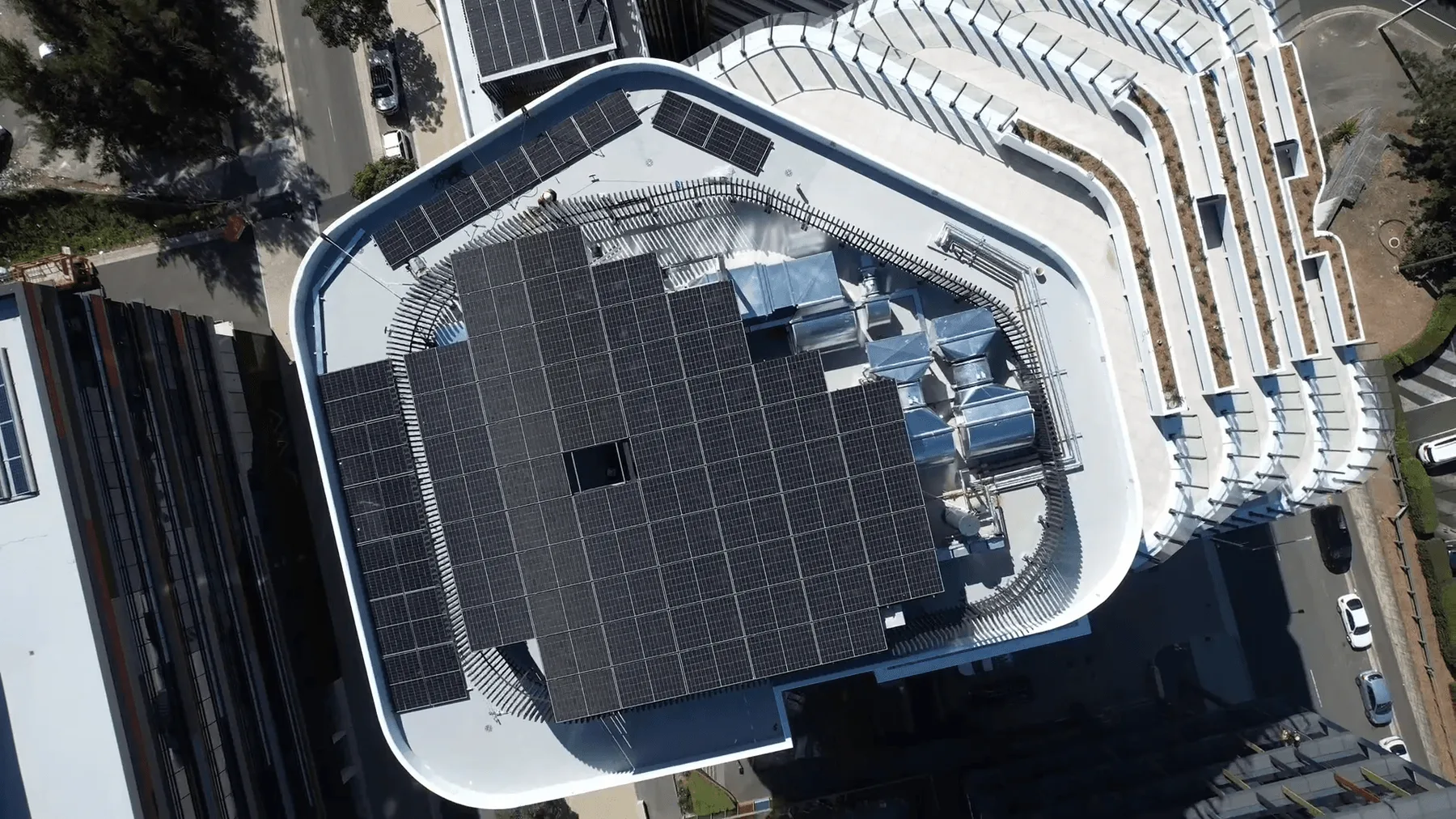
Apartment roofs are contested space. Plant sits on them. Lift overruns sit on them. There is common property to negotiate and shading from whatever was built next door in the last decade. Available area is routinely a fraction of the building's footprint, and what remains is rarely well oriented.
So a proposal that requires an array before anything else can happen tends to stall at the same point every time: a feasibility discussion about a roof that was never going to carry much, ending in a number that does not justify the meeting it took to produce.
Committees read that as solar not working here, and the file closes. The accurate reading is narrower. Solar at a scale worth the capital does not work on that roof. Nothing has been established about storage, because storage was never priced on its own.
Removing the solar precondition inverts the sequence. A building can install the battery first and look at generation later, or never.
What the building has to be
The activity covers residential flat buildings, Class 2 under the National Construction Code 3.
No maximum number of dwellings applies, which is deliberate: large complexes were included so that shared batteries able to deliver material peak demand reduction are not excluded by size 2.
There is a usable capacity band, and usable is not nameplate. Capacity is the second thing a committee should establish, and it is the one most likely to move a building in or out of eligibility after a proposal has already been written.
A minimum copayment applies, so the incentive is a contribution rather than a full cost transfer 2.
What it can be combined with
Two federal conditions decide whether a second incentive can sit on top of the state one, and they are where the two schemes stop lining up neatly for a building with no array.
The Commonwealth program requires the battery to be paired with solar, new or existing 4. That is a federal requirement, not a New South Wales one. A building using the state activity to install storage on a roof with no array meets the state condition and does not meet the federal one.
And a grid-connected battery has to be capable of joining a virtual power plant. Actually joining one remains a choice 4.
Neither stops the state activity applying. Both decide whether a second incentive is available, which is a different question and one worth settling before a proposal is priced either way.
What a committee should do with this
Raise it at the next meeting. Not because anything is closing, and not because anything is running out. The activities sit inside an ongoing scheme with no deadline attached, and a proposal that tells you otherwise is telling you something about the party that wrote it.
Raise it because the eligibility is new. Most energy proposals currently sitting in front of committees were written before this activity existed, so a battery-first option may not have been priced at all.
Three questions are worth putting to whoever wrote yours. Which activity is this proposal claiming under, and has the building's classification been confirmed against it. What is the usable capacity of the proposed system, and where does that sit in the band. And if the roof cannot carry an array worth installing, what does the proposal look like with the battery alone.
What we cannot tell you
We cannot tell you what your building will receive, and neither can anyone else before the eligibility work is done.
The value of a certificate-based incentive depends on the activity, the capacity, the building and the certificate price on the day. Three of those four are properties of your building. The fourth is a market. A figure quoted before any of them has been established is a figure somebody has assumed on your behalf.
What we can tell you is which activity a building appears to fall under and what conditions sit under it. That is the eligibility check, it happens before anyone quotes, and the application remains the owners corporation's to lodge.
The Peak Demand Reduction Scheme is a New South Wales scheme. It does not run in the Australian Capital Territory.
Citations
-
01
Peak Demand Reduction Scheme NSW Climate and Energy Action · primary The scheme the three battery activities sit under, and what it exists to do. energy.nsw.gov.au
-
02
Energy Security Safeguard Rule change 2026 position paper NSW Climate and Energy Action energy.nsw.gov.au
-
03
Batteries for apartment buildings incentive NSW Climate and Energy Action · primary The apartment activity, its building class and its dwelling threshold. energy.nsw.gov.au
-
04
Cheaper Home Batteries Program Department of Climate Change, Energy, the Environment and Water · primary, federal The federal program, its solar pairing and virtual power plant conditions, and the reported stacking allowance. dcceew.gov.au
The 2026 incentives · 04 of 08
Next Why commercial solar systems stop at 99 kW Start at the beginning: Which battery incentive does your site fall under?Keep reading
Which battery incentive does your site fall under?
From 1 September 2026 NSW runs three commercial battery incentives. They are not three tiers of one scheme. Three questions decide which one…
Read Rebates & FinanceThe three NSW battery incentives, and who each one covers
If you have been following the home battery rebate, this is not that scheme. What commences on 1 September 2026, and which sites it applies to.
Read Rebates & FinanceWhy nobody can quote you an exact figure
The NSW commercial battery incentive is delivered through certificates, and certificates carry a market price. An exact dollar figure in a proposal…
Read